Showing posts with label LEED. Show all posts

Mar 31, 2009

Green Initiatives: Too Much, Too Fast

In unison with every other global industry, the architectural community has not managed to escape the tribulations accompanying the global financial status. The Architectural Billing Index reached an all-time low in January, 2009 and has only risen to a still discouraging score of 35.3 for the month of February. McGraw-Hill Construction reported that the value of new construction starts fell 15 percent for 2008, to $547 billion. Given the bleak economic expectations for 2009, experts are already predicting total development starts to slip another 11 percent, with double-digit declines for multifamily housing and commercial building throughout the year. Foster Architects, one of the industry's signature architectural corporations, famous for buildings such as the Reichstag in Berlin and the newly finished Beijing International Airport just announced that they would be laying off more than 300 employees. While one might look at these statistics and assume that the entire state of the architectural business is grim, this is not the case. One component of the industry that is enduring is the field of green design. Architectural firms are busy with inquiries regarding energy efficient upgrades, technology teams are continuously developing more advanced forms of green architectural products, and LEED certification is an almost necessity for a new building proposal. Green initiatives are actually being seen as a key mechanism in lifting up the United States' economy. Within President Barack Obama’s stimulus package, there are approximately $120 billion being allocated to "construction-related spending". Under that umbrella lies a substantial amount of assets specifically intended for technological upgrades. With that being said, I decided to focus this week on controversial trends within the world of green architecture. While green design is gaining steem and contributing to our economy and global initiative, there are many problems associated with such rapid growth of the movement. In order to preserve the social and economic relevance of the idea, we as a society need to be certain that we don't bite off more than we can chew, burning ourselves out before the philosophy has an opportunity to fully mature.

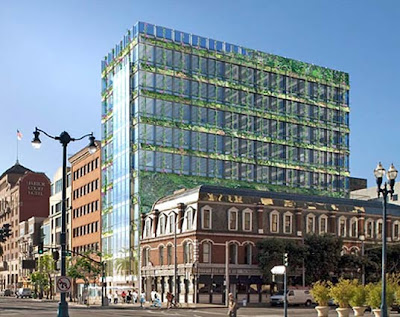
Rich in culture and history, San Francisco is known as one of the most liberal and forward thinking cities in the world. In recent years, San Francisco has also been an extremely ecologically conscious community. As seen in the trendsetting, Morphosis designed Caltrans and San Francisco Federal buildings, city officials have been on the forefront of requiring government structures to be LEED certified. In 2007, San Francisco went as far as to ban styrofoam cups and other utensils from sale in restaurants and stores due to their non-recyclable qualities. While the Golden Gate City has continuously been praised throughout the environmental community, the city’s Board of Supervisors have not long ago come under criticism for their vote to halt the progress of a new ten-story building that is already being dubbed “The greenest building in the west”. Construction on what would be a LEED Platinum building letup due to public outcry claiming that the new project would be imposing upon the historical significance of the site. Critics claim that the structure, located at 110 Embarcadero Street is the former location of the headquarters of the International Longshoreman’s Association and the site of a 1934 police slaying of two ILA workers. The Board of Supervisors have chosen to put the construction on hold in order to investigate the validity of these statements and to then decide whether or not it would be appropriate to erect the building. Currently, the only structure that resides at the site is a battered, dilapidated building that regardless of potential historical significance does not suit the economic importance of the location.

I find it surprising that local residents of San Francisco would protest the creation of a one of a kind environmentally cognizant structure that would double as a neighborhood landmark and an international innovator. While I can recognize the importance of a historical landmark, the site has been nothing more than a decayed mound of concrete for years, serving as no monument to the event. Project developer Paul Paradis describes the site, "This building doesn’t have anything left. It’s been renovated so many times it doesn’t look anything like the building of 1934. There is no physical tie anymore". Whether it is done intentionally or not, a world-renowned architectural gem would be a historical marker that is dissimilar to any other historical event. But the blame cannot be placed exclusively on the citizens. Every architect knows that the first job associated with a new design project is thorough site analysis. This includes any historical incident that might impact a design move. Pelli Clarke Pelli Architects should have had the foresight to know what they were getting themselves into and how they could integrate a historical event into their creation. But this affair also poses a different question that has to do with the limits of green architecture. At what point do people deem sustainability impractical? All it took for San Francisco natives to turn on efficient design was a forgotten longshoreman’s dispute. This event could be seen as an indicator that while this generation is certainly environmentally aware, we may not be ready to practice what we preach. It is more important than ever for the environmental movement to begin to sway from awareness to action.

Another green breakthrough that is causing some debate within the design community is a new applied science that has been developed by Konarka that incorporates solar powering into clothing. Researchers have developed an uber-efficient photovoltaic that could be applied liberally and discretely to clothing, shop awnings, bags, and even umbrella linings. The light would then be used to generate renewable electricity in the form of LED lighting, battery chargers, and heaters. The technology has the potential to revolutionize the clothing industry and create the most widespread form of environmentally conscious activity in history. However, Konarka is not the first company to attempt to apply renewable energy to clothing. The trend began to pop up in the fashion world as early as 1996 with the Lapidus designed solar parka that was displayed in New York for the illustrious Fashion Week. Ever since, high fashion designers such as Ermenegildo Zegna, Willy Bogner, and Andrew Schneider have continually tried to integrate viable power into couture with no avail. The problem with eco-clothing is that it is too small scale and inefficient to move into a mainstream social circuit such as couture. Also, the clothing market is too vulnerable to public norms and popular train of thought for the green movement to have a significant impact. Another legitimate concern is the message being displayed by wearing a heat lamp jacket or an LED infused I-pod charging pair of pants might be too bold of a public statement. I do not think there are many people that are so dedicated to the movement as to be a walking billboard for renewable energy. If we as a society cannot get a self-sustaining building get developed without public protest, how can we expect people to purchase and wear solar panels around their necks? Since the fashion industry has already proven itself unprepared and too fragile for the green movement, Konarka needs to invest in market research to determine which market to inject their fabric into. Another problem plaguing the eco-garment industry is the overhwhelming costs associated with the manufacturing of goods classifyable as enviornmentally neutral. Olsen Haus, the designer of Pure Vegan Shoes notes, "The cost of organic, eco, raw materials is more expensive, so designers are spending more money to make a product that is better for the environment, humans and animals". With the price of these clothes being significantly higher than standard brands, evolution of the potentially revolutionary industry is stymied. In order for the trend to gain significant momentum, a grassroots industry approach would be a way to investigate high material costs while also gradually introducing the product to consumers.

As environmental awareness continues to dictate trends in the creative community, architects and engineers need to be cognizant of their role in conserving the longevity of the trend. Actions ranging from engaging local citizens in the design process to carefully planning the application of modern technology are critical in establishing new eco-systems as realistic means of power. For ddeas are only as effective as their applications, and when factoring in the avant-garde nature of clean energy careful planning is necessary for success.

Feb 23, 2009

Green Solutions: What Equation Are We Really Solving?

With consideration being given to contemporary global issues, the architecture industry is focusing its aim evermore precisely on advancements in green technologies / industries. Revolutionary design teams throughout the world are thinking up innovative and environmentally-conscious constructions that are pushing the boundary of what we once thought were the capabilities of our “green initiative”. Morris Architects, an architecture firm based in Houston, Texas recently proposed an arousing renovation project that could turn an approximate 4,000 out of commission oil rigs in the Gulf of Mexico into eco-resorts. At a slightly smaller scale, the New Hampshire based design team Bensonwood just displayed their design for a low cost, zero-energy prefabricated home available for purchase in upcoming months. The home, which was awarded LEED Platinum Status (U.S. Green Building Council's highest rating for green building construction) is available for installation for approximately $300,000. While revolutionary thinkers in the design industry are doing their part to expand upon green initiatives, I decided to explore the blogosphere in search relevant political and urban planning related issues. I examined a post by Brian Merchant entitled California’s New Budget Delays Regulation of Deadly Diesel Pollution on the TreeHugger.com blog. In the post, Merchant brings forth the ecological shortcomings of California’s new budget. In addition, I observed a post by Clark Williams-Derry entitled Cities Greener than Suburbs from the WorldChanging.com blog. Williams-Derry’s post analyzes a recent study which deduced that living in a dense urban environment creates a smaller carbon footprint than living in the suburbs. My insight and analysis to these two articles can be found below and on their particular websites.

“California Budget Delays Regulation of Deadly Diesel Pollution”
Comment

Being a resident of California my entire life, I too am concerned for the condition of the state as a whole. I appreciate your diligent analysis of the irresponsibility’s of the state legislature in passing the new budget with its lack of green initiative. While I can recognize the serious ramifications of passing the budget with the absence of ecological reform, I think it is also important to consider how grave the California financial crisis is as a whole. The California unemployment rate is almost at 10%, the state’s total debt ($42 billion) rivals that of many developed countries, and the darkest clouds of the recession are still to come. With no end in sight, it is a top priority to have a budget laid out and initiated as quickly as possible, even if that means that some obvious issues are negated. I can appreciate you mentioning the serious health factors at stake, but you might be expecting a slight bit too much from California. It is quite the feat to have our state’s most important budget proposal thought up, written out, passed in legislature, and executed. Arguably the toughest of those processes is going through the legislative process. I’m sure it is safe to assume that careful consideration was given to the grueling nature of the process while the budget was being drafted. You mentioned yourself, “…months of ugly stalemate” were the cause of the premature nature of the budget proposal.

While I recognize the importance of a speedy budget proposal, I do agree with you in that there are many environmental issues being neglected in the package. In addition to the diesel fuel crisis, the budget approval will also be lifting many already existing environmental hurdles in order to speed up the permit process for 10 major road construction projects. While I’m sure this is successful in stimulating the state economy, this is certainly one of the evident slaps in the face to all green thinkers. The state budget also plans to exempt many crucial environmental regulations in the hopes of creating a more efficient excess state property sale process. It would be safe to assume that there are probably hundreds of other social groups with legitimate concerns and complaints about the budget plan. It is unfair to place the environmental agenda above any others’. When analyzing the legitimacy of the budget proposal, it is important to consider the first priority of the state budget proposal… to financially stabilize the state.

“Cities Greener than Suburbs”
Comment

I find it interesting how it was only 20 years ago that the notion of moving to the suburbs was deemed the most socially accepted / conscious choice an American young professional could make. It’s exciting to watch as writers like yourself are beginning to note the obvious inconveniences and general incompetence associated with the suburban American lifestyle. It’s encouraging to hear intelligent factual analysis begin to be incorporated in discussion of the fallacies of suburban neighborhoods. As a designer, the notion of a makeshift community evolving arbitrarily 30 miles away from all relevant forms of life is innately flawed. I am glad to hear the scientific community contribute to the hopeful demise of the suburban routine. I think it is going to be extremely thrilling to watch as environmental concerns begin to play a greater factor in determining urban sprawl than out of date social norms.

While I agree that city suburbs’ mistreatment of transportation and clean electricity supplies contribute heavily to hazardous C02 emissions, I think that the fundamental ideologies that are existent within our societies are more of a concern than individual urban strategies. I live in an extremely urban neighborhood in Los Angeles, a neighborhood where people drive to the supermarket that is five walking minutes away from their home. As much as I would love to imagine it, I don’t ever imagine myself using any form of transportation other than my car to reach the supermarket. This is partly due to the environment I live in, but it is mostly due to the fact that I am a product of the American lifestyle that hasn’t placed enough of an emphasis on efficiency and global responsibility in our day to day lives. I would blame this on a (general) lack of eco-initiative coming from Washington and state departments. It is only now that environmental concerns are beginning to impact the way government policy is formed. Only through actions like the current California State budget proposal’s 12% gasoline tax will people begin to realize and question the inefficiencies that exist in their lives.
 
Creative Commons License
This work is licensed under a Creative Commons Attribution-Noncommercial-No Derivative Works 3.0 United States License.