Showing posts with label Architectural Billing Index. Show all posts

Mar 31, 2009

Green Initiatives: Too Much, Too Fast

In unison with every other global industry, the architectural community has not managed to escape the tribulations accompanying the global financial status. The Architectural Billing Index reached an all-time low in January, 2009 and has only risen to a still discouraging score of 35.3 for the month of February. McGraw-Hill Construction reported that the value of new construction starts fell 15 percent for 2008, to $547 billion. Given the bleak economic expectations for 2009, experts are already predicting total development starts to slip another 11 percent, with double-digit declines for multifamily housing and commercial building throughout the year. Foster Architects, one of the industry's signature architectural corporations, famous for buildings such as the Reichstag in Berlin and the newly finished Beijing International Airport just announced that they would be laying off more than 300 employees. While one might look at these statistics and assume that the entire state of the architectural business is grim, this is not the case. One component of the industry that is enduring is the field of green design. Architectural firms are busy with inquiries regarding energy efficient upgrades, technology teams are continuously developing more advanced forms of green architectural products, and LEED certification is an almost necessity for a new building proposal. Green initiatives are actually being seen as a key mechanism in lifting up the United States' economy. Within President Barack Obama’s stimulus package, there are approximately $120 billion being allocated to "construction-related spending". Under that umbrella lies a substantial amount of assets specifically intended for technological upgrades. With that being said, I decided to focus this week on controversial trends within the world of green architecture. While green design is gaining steem and contributing to our economy and global initiative, there are many problems associated with such rapid growth of the movement. In order to preserve the social and economic relevance of the idea, we as a society need to be certain that we don't bite off more than we can chew, burning ourselves out before the philosophy has an opportunity to fully mature.

Rich in culture and history, San Francisco is known as one of the most liberal and forward thinking cities in the world. In recent years, San Francisco has also been an extremely ecologically conscious community. As seen in the trendsetting, Morphosis designed Caltrans and San Francisco Federal buildings, city officials have been on the forefront of requiring government structures to be LEED certified. In 2007, San Francisco went as far as to ban styrofoam cups and other utensils from sale in restaurants and stores due to their non-recyclable qualities. While the Golden Gate City has continuously been praised throughout the environmental community, the city’s Board of Supervisors have not long ago come under criticism for their vote to halt the progress of a new ten-story building that is already being dubbed “The greenest building in the west”. Construction on what would be a LEED Platinum building letup due to public outcry claiming that the new project would be imposing upon the historical significance of the site. Critics claim that the structure, located at 110 Embarcadero Street is the former location of the headquarters of the International Longshoreman’s Association and the site of a 1934 police slaying of two ILA workers. The Board of Supervisors have chosen to put the construction on hold in order to investigate the validity of these statements and to then decide whether or not it would be appropriate to erect the building. Currently, the only structure that resides at the site is a battered, dilapidated building that regardless of potential historical significance does not suit the economic importance of the location.

I find it surprising that local residents of San Francisco would protest the creation of a one of a kind environmentally cognizant structure that would double as a neighborhood landmark and an international innovator. While I can recognize the importance of a historical landmark, the site has been nothing more than a decayed mound of concrete for years, serving as no monument to the event. Project developer Paul Paradis describes the site, "This building doesn’t have anything left. It’s been renovated so many times it doesn’t look anything like the building of 1934. There is no physical tie anymore". Whether it is done intentionally or not, a world-renowned architectural gem would be a historical marker that is dissimilar to any other historical event. But the blame cannot be placed exclusively on the citizens. Every architect knows that the first job associated with a new design project is thorough site analysis. This includes any historical incident that might impact a design move. Pelli Clarke Pelli Architects should have had the foresight to know what they were getting themselves into and how they could integrate a historical event into their creation. But this affair also poses a different question that has to do with the limits of green architecture. At what point do people deem sustainability impractical? All it took for San Francisco natives to turn on efficient design was a forgotten longshoreman’s dispute. This event could be seen as an indicator that while this generation is certainly environmentally aware, we may not be ready to practice what we preach. It is more important than ever for the environmental movement to begin to sway from awareness to action.

Another green breakthrough that is causing some debate within the design community is a new applied science that has been developed by Konarka that incorporates solar powering into clothing. Researchers have developed an uber-efficient photovoltaic that could be applied liberally and discretely to clothing, shop awnings, bags, and even umbrella linings. The light would then be used to generate renewable electricity in the form of LED lighting, battery chargers, and heaters. The technology has the potential to revolutionize the clothing industry and create the most widespread form of environmentally conscious activity in history. However, Konarka is not the first company to attempt to apply renewable energy to clothing. The trend began to pop up in the fashion world as early as 1996 with the Lapidus designed solar parka that was displayed in New York for the illustrious Fashion Week. Ever since, high fashion designers such as Ermenegildo Zegna, Willy Bogner, and Andrew Schneider have continually tried to integrate viable power into couture with no avail. The problem with eco-clothing is that it is too small scale and inefficient to move into a mainstream social circuit such as couture. Also, the clothing market is too vulnerable to public norms and popular train of thought for the green movement to have a significant impact. Another legitimate concern is the message being displayed by wearing a heat lamp jacket or an LED infused I-pod charging pair of pants might be too bold of a public statement. I do not think there are many people that are so dedicated to the movement as to be a walking billboard for renewable energy. If we as a society cannot get a self-sustaining building get developed without public protest, how can we expect people to purchase and wear solar panels around their necks? Since the fashion industry has already proven itself unprepared and too fragile for the green movement, Konarka needs to invest in market research to determine which market to inject their fabric into. Another problem plaguing the eco-garment industry is the overhwhelming costs associated with the manufacturing of goods classifyable as enviornmentally neutral. Olsen Haus, the designer of Pure Vegan Shoes notes, "The cost of organic, eco, raw materials is more expensive, so designers are spending more money to make a product that is better for the environment, humans and animals". With the price of these clothes being significantly higher than standard brands, evolution of the potentially revolutionary industry is stymied. In order for the trend to gain significant momentum, a grassroots industry approach would be a way to investigate high material costs while also gradually introducing the product to consumers.

As environmental awareness continues to dictate trends in the creative community, architects and engineers need to be cognizant of their role in conserving the longevity of the trend. Actions ranging from engaging local citizens in the design process to carefully planning the application of modern technology are critical in establishing new eco-systems as realistic means of power. For ddeas are only as effective as their applications, and when factoring in the avant-garde nature of clean energy careful planning is necessary for success.

Feb 16, 2009

Our Future: Up In Flames

With the world economy at the beginning of a seemingly disastrous recession, many global industries are experiencing the toughest times in decades. The field of architecture is no exception. The Architectural Billing Index (ABI) is a fairly new but highly recognized tool that is known as the profession’s best economic indicator. The American Institute of Architects (AIA) administers a business survey to the largest commercial architects in the United States. The responses to the survey reflect a precise correlation between architectural billings and construction spending records. A total score of 50 or above indicates a rise in billings, a score below 50 indicates a decrease. With the score reaching its lowest total in the ABI’s thirteen year history (34.7 for the month of November 2008) and having consistently scored below 50 for the past eleven months, it is no secret that the industry is going through a major slump. With projects ranging from billion-dollar high-rises to 300k home renovations stalling or closing, the industry’s shortcoming are evident at all levels.

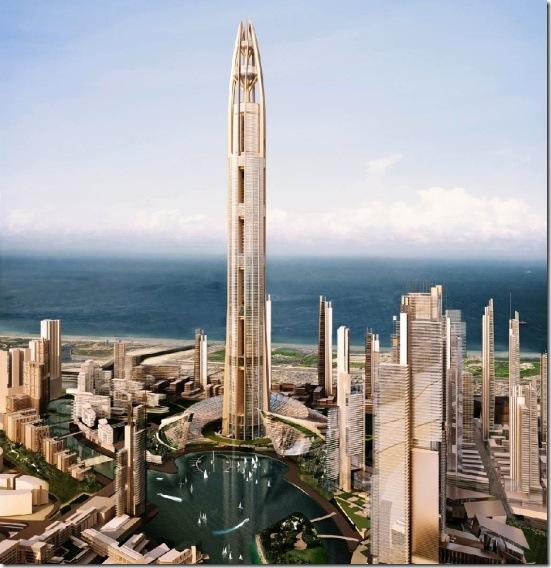
Dubai, which just months ago was considered the forefront for architectural and real estate prowess, is now suffering from some of the hardest design and development setbacks the U.A.E. has ever seen. Just days ago, Nakheel PJSC, the developer that is financing the construction of the latest “tallest building in the world” was forced to merge some of the available units. This move takes a crucial toll on the original design of the building as well as the building’s overall intentions and purpose. The decision to make this move is more startling to architects than it is developers, considering it is the architect’s design that is being compromised in order to preserve the overall project. This announcement follows last months traumatizing decree that construction on the building itself will be delayed. The two main culprits of this stop in architectural progress are the global financial market’s current limitations in lending as well as Dubai’s 25% drop in property prices from their peak in September. Seen more as an inspirational blow to architects than anything else, the come down of Dubai’s architectural aptitude is a depressing sign of the field’s current status. It was only months ago that “starchitects” such as Zaha Hadid, Rem Koolhaas, and Herzog & de Meuron were unveiling projects that were incomparable to anything else in the world. Projects that were viewed as inspirational masterpieces to the whole architectural community are now being subject to doubt. For architects, this event is comparable to a small child watching as Disneyland is forced to close its doors or if a musician heard the news that Coachella was being cancelled. Is it possible that that which Dubai represents architecturally will survive the financial climate? Hopefully. But how much of an impact will this have on architects, developers that finance projects, and our creative ideas themselves?

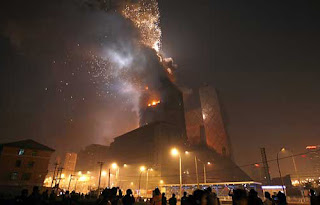
Another incident that is being seen as a bizarre but catastrophic morale bruiser is the recent torching of the TVCC building in Beijing, China. The giant CCTV complex buildings consist of the China Central Television Station tower, and a separate but adjacent Television Cultural Center tower which was meant to contain a luxury hotel, cultural center, and retail establishments. Both buildings are questionably Rem Koolhaas’ and Ole Scheeren’s greatest design achievements yet. While the CCTV building opened in December of 2008, the TVCC was due to open in May 2009. In the peculiar incident, a Lantern Festival fireworks accident was the cause of the ignition of the building. A tradition in Chinese culture, the Lantern Festival commemorates the conclusion of the Chinese New Year and involves children going out at night to play under the light of fireworks. Ironically, a CCTV employee ignited the firework that lit the neighboring building aflame. The firework hit the ground floor of the TVCC building, and then grew to consume the building. Koolhaas and Scheeren were originally criticized for their participation in the construction of an $800 million building housing an organization (CCTV) who’s goal is wide spread censorship and questionable human rights activities. However, Koolhaas later expressed his intentions for design contributing to political evolution when he said, “with an effort to support within [China's] current situation the forces that we think are progressive and well-intentioned… We’ve given them a building that will allow them to mutate.” While the intentions of the building might have been in question, there is no denying the architectural masterpiece that the CCTV campus is. Clad in a beautiful zinc titanium alloy and shaped as a distorted boot, the TVCC building was intended to be the “little brother” to the giant CCTV building. Nicknamed the “fun place” by architects that designed the two towers, TVCC was supposed to be the more lighthearted piece of the monolithic CCTV structure. While the children of Beijing might have been treated with the greatest fire display in recent Lantern Festival history, the architectural community is shocked at the destruction of an icon that didn’t get to be. While it is uncertain what the plans are for restoring the burnt tower, the emotional impact of watching the masterpiece erupt in flames is devastating. But almost more shocking than the fire itself, the cause of hundreds of millions of dollars in damage was a $5 bottle rocket. The ability of a colossal structure like the TVCC building to be so easily destroyed must shock the core of an architect’s thought process.

The world economy’s impact on the architecture community is also being seen closer to home. Plans for Downtown Los Angeles’ revitalization are being grounded as funds for projects are dwindling. Four separate plans for $1 billion plus projects have been frozen in past weeks. Related Cos.’ $3 billion development was just put on hold, Moinian Group’s $1 billion project has been halted, Houk Development Company’s $1.3 billion skyscraper has been arrested, and IDS Real Estate Group’s $1 billion residential tower has also been stopped. Oskar Brecher, director of development for the New York-based Moinian Group said, “The credit markets are all seized up, especially for a project of this size. The ability of banks to finance large projects... is just nonexistent.” Developers of downtown Los Angeles which have had such ambitious plans for revitalization are being forced to sit back and wait while the larger powers that be are trying to deal with the economic situation. As a resident of downtown Los Angeles I too am being forced to sit back and watch idly as my neighborhood sits at a middle-ground between successful urban metropolis and desolate cityscape. I can only hope that developers, residents, and those thinking of future plans for downtown stick the course and understand that times will eventually change. It is important for people to consider the success of L.A. Live when considering whether or not to follow through with plans for other billion dollar projects downtown. While I understand that my professional expertise probably isn’t as relevant in solving this problem as a developer’s, it is important to acknowledge the architect’s role in the equation at hand. A designer’s fundamental upbringing could play an integral part in the diagnosis and prevention of future meltdowns.

Understanding that architecture and construction comprise a large portion of the nation's economic status, Congress recently passed President Obama’s $838 billion economic stimulus package that incorporates many architecturally related proposals. The package primarily focuses on the demand for energy-efficient buildings and the proposal for federal facilities. The details of the plan consist of $7.7 billion for the U.S. General Services Administration (GSA) $6 billion being allocated specifically towards energy-efficient upgrades, $1 billion for border station construction projects/upgrades, and $10 billion for U.S. defense projects. While this proposal offers a great deal of encouragement to the architectural community, many are already doubting whether this is enough of a spark to affect the architectural community itself. One crucial issue is that the government is saying that there are approximately $10 billion in projects that are “ready-to-go”, meaning that groundwork could begin as soon as needed. If this were the case, the role of the architect is being skipped. The priorities of the GSA have a lot to do with who gets to benefit from the stimulus package. Kevin Kampschroer, director of the GSA’s Office of Federal High-Performance Green Buildings said, “If we have a design that was done five years ago, before the Energy Policy Act of 2005 was passed, there would be work needed to bring it up to today’s expectations.” This is promising, but the beginnings of a neglecting undertone already seem to be forming in the statement. Another issue at stake is what role the small architecture firms might play in the package. In order to nurture long term economic success, the stimulus package needs to include smaller firms in some way. It is unclear at this point how it will plan to do so.

While the economy has caused a lot of decline in design community, there are still dynamic projects that have remained afloat. For instance, the $198 million Spaceport America Project is still underway in the desert of Upham, New Mexico. Architect Norman Foster designed the project which is intended to accommodate up to five spacecraft. New Mexico Governor Bill Richardson announced that the state just signed a 20 year lease with Virgin Galactic to solidify the project. Another intriguing art project that has taken form due to the economy is a collection of photographs taken by Japanese artist Todd Hido. The exhibit documents the interior of foreclosed homes. Now we can sleep peacefully at night knowing that while artists wallets might be hurting during the economic crunch, at least their creative spirit hasn’t been harmed.
 
Creative Commons License
This work is licensed under a Creative Commons Attribution-Noncommercial-No Derivative Works 3.0 United States License.